
It started with a photograph.
A mother in my clinic sat across from me, holding her phone with slightly trembling hands, showing me a picture of her three-year-old daughter. In the photo, one of the little girl’s eyes was turned inward. Just slightly. Just enough to notice — if you were really looking.
“I thought it was the camera angle,” she said quietly. “I told myself it was nothing. But then I started watching her more carefully, and I kept seeing it. She squints when she looks at the TV. She turns her head a little when I call her name from across the room.”
She paused.
“I should have come sooner, shouldn’t I?”
I hear some version of this story almost every week. And my answer is always the same — you are here now, and that is what matters most. But I also tell every parent the truth: when it comes to squint in children, the sooner we act, the better the outcome.
This article is written for every parent who has noticed something in their child’s eyes and is not sure what to do about it. I want to walk you through everything — what squint actually is, why it happens, what the warning signs look like, and most importantly, what we can do about it.
First — What Exactly Is a Squint?
The medical term is strabismus, but most people simply call it a squint or crossed eyes. It refers to a condition in which both eyes do not point in the same direction at the same time.
In a normally functioning visual system, both eyes work as a team. They point at exactly the same object simultaneously, and the brain combines the two slightly different images from each eye into one single, clear, three-dimensional picture. This teamwork is called binocular vision, and it gives us depth perception — the ability to judge distances accurately.
In a child with squint, one eye points straight ahead while the other drifts — inward (which we call esotropia), outward (exotropia), upward (hypertropia), or downward (hypotropia). Because the eyes are not aligned, the brain receives two conflicting images instead of one unified picture.
The brain, being remarkably adaptable, deals with this problem in the only way it knows how — it begins to ignore the image coming from the misaligned eye. This suppression happens gradually and silently, and over time, the ignored eye loses its ability to develop normal visual sharpness. This is how squint leads to amblyopia — commonly known as lazy eye — one of the most important and preventable causes of permanent vision loss in children.
Why Do Children Develop Squint?
This is one of the questions parents ask me most often, and understandably so. When your child is diagnosed with squint, one of the first things you want to know is — why did this happen?
The honest answer is that there are several different causes, and in many children, a combination of factors is responsible.
Refractive errors are among the most common culprits. Children who are significantly long-sighted — what we call hyperopia — have to work their focusing muscles very hard to see clearly. This extra focusing effort can trigger the eyes to turn inward, causing a type of squint called accommodative esotropia. In these children, simply prescribing the correct glasses often corrects the squint entirely or significantly — which is why an accurate spectacle prescription is always the starting point of treatment.
A family history of squint increases the likelihood that a child will develop it. If a parent, sibling, or close relative has or had squint, the risk for a child is meaningfully higher. This does not mean squint is inevitable — but it does mean vigilant monitoring from an early age is wise.
Problems with eye muscle control can cause squint in some children. The six muscles that control each eye’s movement must work in precise coordination. If any of these muscles are too tight, too loose, or controlled by nerve signals that are not functioning normally, the result can be misalignment.
Neurological conditions can sometimes underlie squint, particularly when it develops suddenly in an older child who previously had normal eye alignment. Conditions affecting the brain or brainstem — including raised intracranial pressure — can cause certain types of squint. This is one reason why sudden onset squint in any child warrants prompt medical evaluation.
Premature birth and low birth weight are associated with higher rates of squint and other eye problems. Premature infants receive regular ophthalmological screening for precisely this reason.
Other eye conditions — including congenital cataract, significant anisometropia (very different prescriptions in the two eyes), and retinal disorders — can cause squint by depriving one eye of clear visual input during the critical developmental period.
And in a proportion of children, particularly those with what we call infantile esotropia — the large angle inward squint that develops in the first six months of life — the precise cause remains unclear. What is clear is that prompt treatment is essential.
The Signs Every Parent Should Know
Here is something I tell every parent in my clinic: you know your child better than anyone. If something about their eyes looks or feels different to you, trust that instinct and get it checked. The following signs are the ones that should prompt a visit to a paediatric eye specialist.
One eye turning in, out, up, or down — this is the most obvious sign, but it is worth emphasising that the deviation can be subtle, intermittent, or most noticeable only under certain conditions. Some children only show the squint when they are tired, ill, or concentrating hard on something. The fact that it is not constant does not mean it is not real or not significant.
Squinting or partially closing one eye — particularly in bright sunlight or when trying to focus on something at distance. This is the child’s way of trying to reduce the confusion caused by receiving two misaligned images. It is a compensatory behaviour, and it is a clear sign that something needs attention.
Head tilting or turning — if you notice your child consistently tilting their head to one side or turning their face when looking at objects or people, this can be a sign of squint or a related condition called nystagmus. The child is trying to use a specific head position to achieve the best possible alignment of their eyes.
Closing or covering one eye — some children instinctively cover or close one eye, particularly when looking at something in the distance. This reduces the double vision or visual confusion caused by the misalignment.
Bumping into things or misjudging distances — squint disrupts the depth perception that binocular vision provides. A child with significant squint may trip over steps, struggle to catch or kick a ball, or seem generally less spatially aware than their peers.
Poor academic performance or reading difficulties — a child who cannot see clearly because of an uncorrected squint and developing amblyopia may struggle in school. They may complain of headaches after reading or writing, hold books unusually close to their face, or lose their place frequently when reading.
Complaints of double vision — older children can articulate this symptom directly. If your child tells you they are seeing double, take it seriously and arrange an urgent eye examination.
A white or unusual reflection in the pupil in photographs — this is less commonly associated with squint specifically, but any abnormal pupil reflex in a photograph — particularly a white reflex instead of the normal red-eye — should be treated as urgent. It can indicate retinoblastoma or other serious intraocular conditions.
The Critical Window — Why Timing Is Everything
I want to spend a moment on something that I believe every parent of a young child should understand deeply, because it genuinely changes outcomes.
The visual system is not fully formed at birth. It develops and matures rapidly during the first years of life — and critically, it requires clear, equal visual input from both eyes to develop normally. This period of rapid visual development, during which the brain’s visual processing pathways are being laid down, is called the critical period.
The critical period lasts approximately until the age of seven to nine years — though the earlier within this window that treatment begins, the better the outcome.
If a child has squint during the critical period, the brain begins to suppress the image from the misaligned eye to avoid double vision. The suppressed eye stops sending strong signals to the brain. The brain, receiving little meaningful input from that eye, allocates progressively fewer neurons to processing its signals. Over time, the visual acuity in the suppressed eye declines — not because there is anything wrong with the eye itself structurally, but because the brain has essentially stopped learning to use it properly.
This is amblyopia — lazy eye — and it is the most important long-term consequence of untreated squint.
Here is the critical point: amblyopia treated within the critical period can be corrected. Amblyopia detected and treated after the critical period — in an older child or adult — is largely irreversible.
This is why I feel so strongly about early detection and early treatment. A child whose squint is caught and treated at age two or three has an excellent chance of developing normal or near-normal vision in both eyes. A child whose squint goes undetected until age ten has a significantly reduced chance of recovering full visual function in the affected eye — no matter how good the treatment.
This is not meant to cause guilt or panic in parents who are reading this with an older child. It is meant to motivate action. If you suspect your child has a squint — at any age — get it evaluated now.
How We Diagnose Squint at Bhakti Netralaya
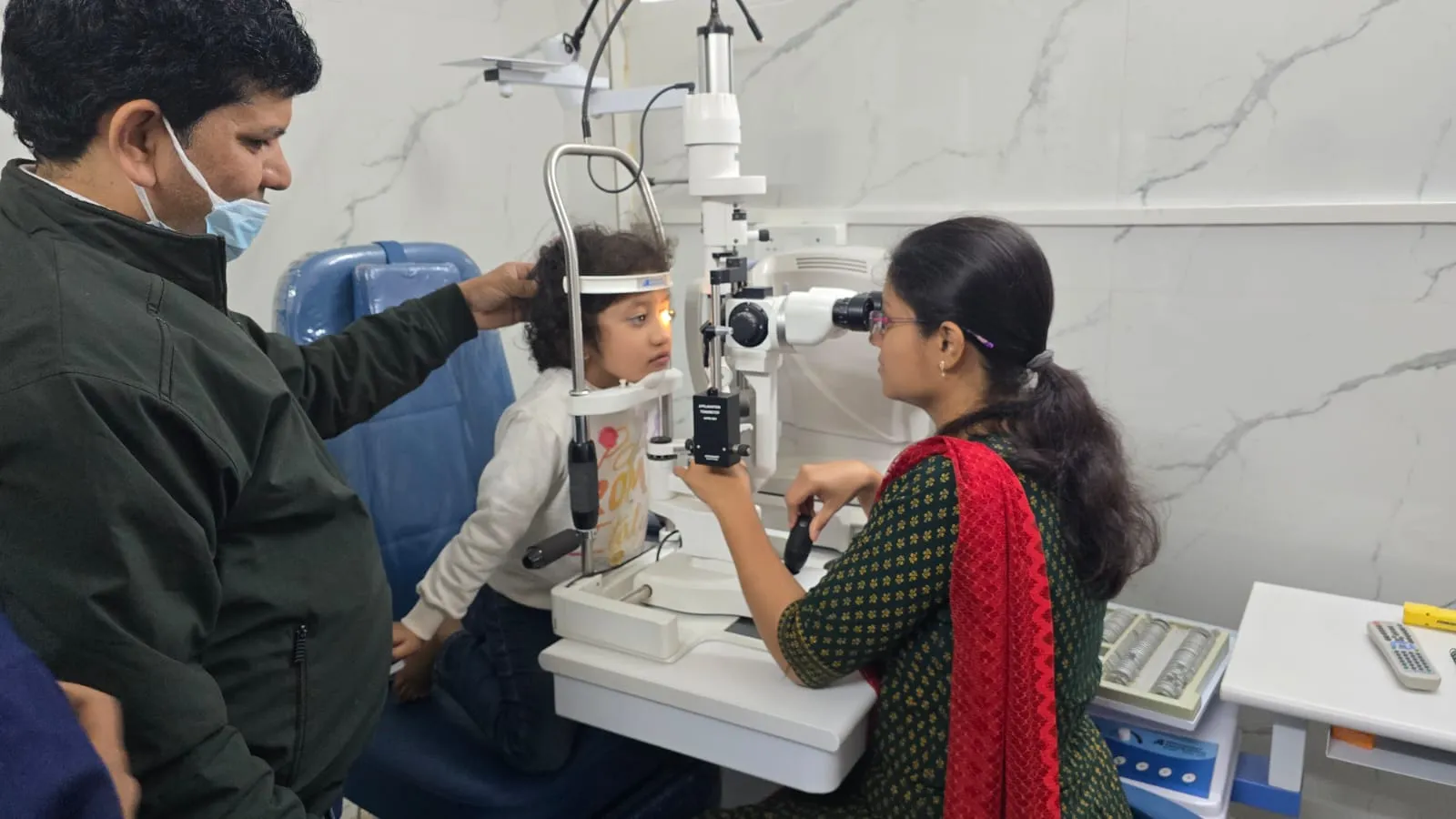
When a child comes to our Paediatric Ophthalmology clinic at Bhakti Netralaya, I take a thorough, unhurried approach to examination. Children are not small adults — they require a completely different approach to eye testing, and a clinic that understands this makes a meaningful difference to both the accuracy of the diagnosis and the comfort of the child.
Our assessment includes a detailed cover test to identify the presence, direction, and magnitude of the squint. We measure visual acuity in each eye — even in very young children and pre-verbal infants, where specialised paediatric testing techniques are used. We perform a cycloplegic refraction — using dilating eye drops to temporarily relax the focusing muscles and measure the true refractive error without interference from the child’s accommodative effort. This step is absolutely essential and cannot be skipped in children.
We assess ocular motility — the full range and quality of eye movements in all directions. We examine the anterior and posterior segments of the eye to exclude any underlying structural cause for the squint. And where indicated, we perform orthoptic assessment — detailed measurement of the angle of deviation and assessment of binocular function.
This comprehensive evaluation gives us everything we need to plan the most appropriate, individualised treatment for each child.
Treatment — What Are the Options?
The good news is that squint is very treatable — particularly when detected early. Treatment is not one-size-fits-all; it depends on the type and cause of the squint, the child’s age, and whether amblyopia is present.
Glasses are often the first step, particularly for accommodative esotropia caused by long-sightedness. An accurate cycloplegic spectacle prescription can dramatically reduce or completely eliminate the squint in many children. It can feel surprising to parents that glasses alone can straighten the eyes — but the mechanism is logical. By correcting the refractive error, the glasses reduce the focusing effort that was driving the eye turn, and the eyes naturally align.
Amblyopia treatment — if the squinting eye has developed reduced vision, treating the amblyopia is a priority alongside correcting the squint itself. The most established treatment is occlusion therapy — patching the stronger eye for a prescribed number of hours each day to force the amblyopic eye to work and develop. Atropine penalisation — using drops to blur the better eye — is an alternative to patching in some children. Both approaches work by encouraging the brain to re-engage with the weaker eye during the critical developmental period.
Prism therapy — prismatic lenses can be incorporated into glasses to correct small angle deviations, particularly in older children or adults where surgery may not be the preferred option.
Botulinum toxin injection — in selected cases, a small injection of botulinum toxin into one of the overacting eye muscles can temporarily weaken it, allowing the eyes to realign. This approach is used in specific clinical situations and is generally reserved for particular types of acute onset squint or as an adjunct to surgery.
Squint surgery — for many children with squint, surgery is ultimately necessary to achieve the best possible ocular alignment. Squint surgery involves precisely adjusting the tension of one or more of the extraocular muscles to bring the eyes into correct alignment. It is performed under general anaesthesia in children. It is a safe, well-established procedure, and my FPOS training has provided me with advanced expertise across the full spectrum of strabismus surgery — horizontal, vertical, oblique, and complex multi-muscle procedures.
It is important for parents to understand that surgery for squint is not cosmetic. It is a functional procedure that restores proper eye alignment, improves binocular vision, and in many cases significantly improves the effectiveness of amblyopia treatment. Many children require glasses and/or patching both before and after surgery.
Frequently Asked Questions from Parents
My child is only six months old and their eyes seem to cross sometimes. Is this normal?
In the first few weeks of life, intermittent crossing of the eyes is relatively common and usually resolves on its own. However, by around three to four months, the eyes should be consistently aligned. Any squint that is constant, or that persists beyond four months of age, warrants evaluation. Large angle squints in infants always require prompt assessment.
Will my child need to wear glasses forever?
Not necessarily — it depends on the underlying cause. Some children outgrow their refractive error as the eye grows and the squint resolves. Others require long-term glasses wear. We reassess the prescription and the squint at every follow-up visit and adjust the plan accordingly.
What if we do nothing and just wait to see if it gets better?
For most types of squint, waiting is not advisable. Some accommodative squints may fluctuate, but they do not typically resolve without treatment. More importantly, while you are waiting, amblyopia may be developing silently. The risk of doing nothing generally outweighs any perceived benefit of a watchful wait — particularly in young children during the critical developmental period.
Is squint surgery painful for my child?
Squint surgery is performed under general anaesthesia, so your child will be completely asleep and will feel nothing during the procedure. Post-operatively, there is typically some redness and mild discomfort for a few days, which is well managed with prescribed eye drops and simple pain relief. Most children recover very quickly.
Can adults get squint surgery?
Yes. Squint surgery is not exclusively for children. Adults with squint — whether long-standing or newly developed — can benefit significantly from surgical correction. The functional outcomes in terms of binocular vision improvement are generally better in children treated early, but the cosmetic and quality-of-life benefits of surgery in adults are very real and meaningful.
A Final Word to Every Parent Reading This
If you have read this far, it is probably because something about your child’s eyes has caught your attention. Perhaps it is a photograph, a comment from a relative, a nagging feeling that something is not quite right.
Please do not dismiss it. Please do not wait for your next routine check-up and mention it in passing. Make an appointment specifically to have your child’s eyes evaluated by a paediatric eye specialist.
At Bhakti Netralaya, our Paediatric Ophthalmology clinic is led by Dr. Priti Patil — an FPOS-qualified specialist with dedicated training in children’s eye conditions including squint, amblyopia, low vision, and paediatric refraction. Our entire approach is built around making children feel safe, comfortable, and at ease — because an anxious child cannot be properly examined, and a properly examined child gets properly treated.
You do not have to travel to Pune or Nagpur. You do not have to wait months for an appointment at a distant hospital. Expert paediatric eye care is available right here in Malkapur.
Your child’s vision is the foundation of their learning, their confidence, their entire experience of the world. Give it the attention it deserves — early, expertly, and close to home.
About the Author
Dr. Priti Patil is a Paediatric Ophthalmologist and Phacoemulsification Surgeon at Bhakti Netralaya, Malkapur. She holds postgraduate degrees M.B.B.S. and M.S. in Ophthalmology and a Fellowship in Paediatric Ophthalmology and Strabismus (FPOS) — one of the most specialised sub-fellowships in eye care.
Paediatric OPD: 2nd & 4th Monday of every month — 10:00 AM to 4:00 PM
📍 Bhakti Netralaya, Ganesh Nagar, Near Bhadru Mandal, Malkapur, District Buldhana 📞 92096 57063 | 83848 47869
Early booking is strongly recommended as slots fill quickly.